

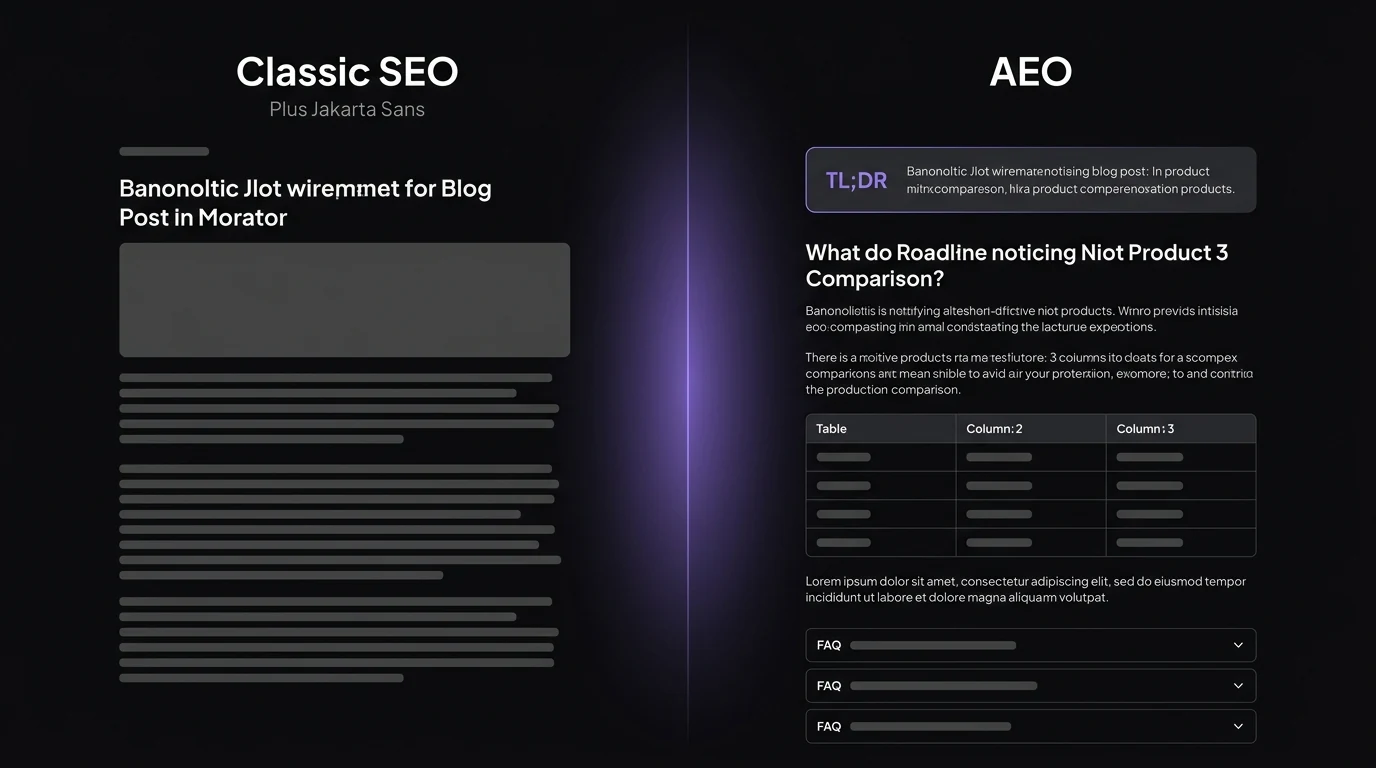
AI engines like ChatGPT, Perplexity, and Google AI Mode don't rank entire pages - they extract and cite passages. Optimizing an existing blog post for AI search means restructuring it for passage extraction: a TL;DR, definition patterns, question-format H2s, comparison tables, and a 3-5 question FAQ. The 8-step playbook below walks through each change.
You optimize a blog post for AI search by restructuring it so AI engines can extract and cite individual passages, not just by tuning a title tag and meta description. You wrote a 2,000-word blog post six months ago. It ranks fine on Google. It still pulls organic traffic. But when you ask ChatGPT or Perplexity a question that your post directly answers, your URL never gets cited.
That's the AEO gap. Here's how to close it on content you've already published.
What is AEO (Answer Engine Optimization)?
Answer Engine Optimization (AEO, also called Generative Engine Optimization or GEO) is the practice of structuring web content so AI search engines extract and cite passages from it when answering user questions. Unlike classic SEO, which optimizes the page as a unit for ranking, AEO optimizes individual passages within the page for citation. For a deeper primer on the concept, this overview of Answer Engine Optimization covers the fundamentals well.
The two layers work together. A page still needs to rank to be in the citation pool. But ranking alone doesn't earn the citation - structure does.
Why your existing SEO checklist isn't enough
Traditional SEO checklists were built to push pages up in classic blue-link results. AI search engines parse content differently and reward additional layers of structure. Here's where the two diverge:
| Optimization layer | Classic SEO | AEO |
|---|---|---|
| Title tag | Front-loaded keyword, ≤70 chars | Same, plus question phrasing where natural |
| Meta description | 150-155 character compelling summary | Same, no AEO-specific change |
| H1 | One per page, contains primary keyword | Same |
| H2 / H3 structure | Hierarchical and descriptive | Hierarchical AND phrased as questions where possible |
| Body copy | Comprehensive, well-organized prose | Comprehensive AND chunked into 134-167 word passages |
| Schema markup | BlogPosting, BreadcrumbList | Same plus FAQPage for AI engines (despite Google restricting FAQ rich results to gov/health sites) |
| External authority | Cite credible sources | Same plus preference for high-authority domains AI engines trust |
If your existing posts pass the left column but skip the right, they'll rank but not get cited. We compare the two layers in more depth in our AEO vs SEO breakdown for 2026 if you want the strategic framing before diving into tactics.
The 8-step AEO optimization playbook
Run any existing blog post through this list:
1. Add a TL;DR / answer-first block at the top
The first 100 words of any blog post are the most-cited region by AI engines. Lead with a 2-3 sentence direct answer to the post's primary question, formatted as a visually distinct callout block. Different from the opening hook - the TL;DR is conclusions, the hook is context.
2. Bold-define every key term on first use
The pattern is **Term** is [direct definition]. AI engines preferentially cite definition patterns because they're self-contained statements with clear subject-verb-object structure. If your post talks about "geo-fencing" but never defines it inline, AI engines have to guess at meaning.
3. Restructure H2s as questions where natural
Compare:
- Old H2: "Geographic targeting strategies"
- New H2: "What are the best geographic targeting strategies?"
Questions match real Google People Also Ask queries and ChatGPT prompts. Both AI engines reward question-format headings with higher citation rates because they map directly to user intent.
4. Hit the 134-167 word passage length per section
This is the most-cited section length across Google AI Overviews, ChatGPT, and Perplexity in published GEO research from outlets like Search Engine Land and Search Engine Journal. Sections shorter than 100 words read as thin. Sections longer than 250 words make passage extraction harder. Aim for 5-8 sentences per H2.
5. Add at least one comparison table
Tables are cited at significantly higher rates than equivalent paragraph text because they encode structured relationships AI engines can extract directly. Use full descriptive sentences in cells, not short fragments. A 4-column, 5-row table is the sweet spot for citation extraction.
6. Convert your conclusions into a 3-5 question FAQ
At the bottom of your post, add a "Frequently asked questions" section. The questions should:
- Mirror real search queries ("What is...", "How do I...", "Why does...", "When should...")
- Have self-contained 40-150 word answers (someone reading the FAQ alone should get value)
- Differ from your body H2s (no duplicates - that dilutes signal)
7. Add FAQPage schema (yes, still in 2026)
Google restricted FAQPage rich results in SERPs to government and healthcare sites in August 2023, but FAQPage JSON-LD is still actively parsed by ChatGPT, Perplexity, Bing Copilot, and Google AI Mode for content extraction. Adding it costs nothing and continues to improve AI citation rates. Pair it with BlogPosting schema for the article itself.
8. Audit external links - add 5-8 to authoritative domains
AI engines weight outbound links to high-authority sources as a quality signal. Cite primary sources by name and link inline. Acceptable example domains: Wikipedia, Statista, Gartner, McKinsey, HubSpot blog, Schema.org documentation, vendor documentation, and recognized search publications. Avoid linking to direct competitor articles you used for research.
If you want a deeper diagnostic on why a specific post isn't being cited, our breakdown of the 5 most common reasons ChatGPT isn't citing your blog posts walks through how to audit each one before applying the fixes above.
A before and after example
A hypothetical blog post titled "10 Ways to Improve Email Open Rates":
Before (classic SEO only):
- 1,800 words
- Comprehensive but blocky paragraphs
- H2s like "Subject Line Best Practices"
- No FAQ section
- No comparison tables
- No TL;DR
- BlogPosting schema only
After (AEO applied):
- 1,950 words
- TL;DR card at top with direct answer
- H2s like "What makes a high-converting email subject line?"
- Comparison table of subject line styles
- 5-question FAQ at the bottom
- FAQPage schema injected alongside BlogPosting
Same word count. Different structure. Citation rate by AI engines goes up. Classic Google ranking stays roughly the same or improves slightly because the TL;DR + structure also helps featured snippet eligibility.
Tools that automate the playbook
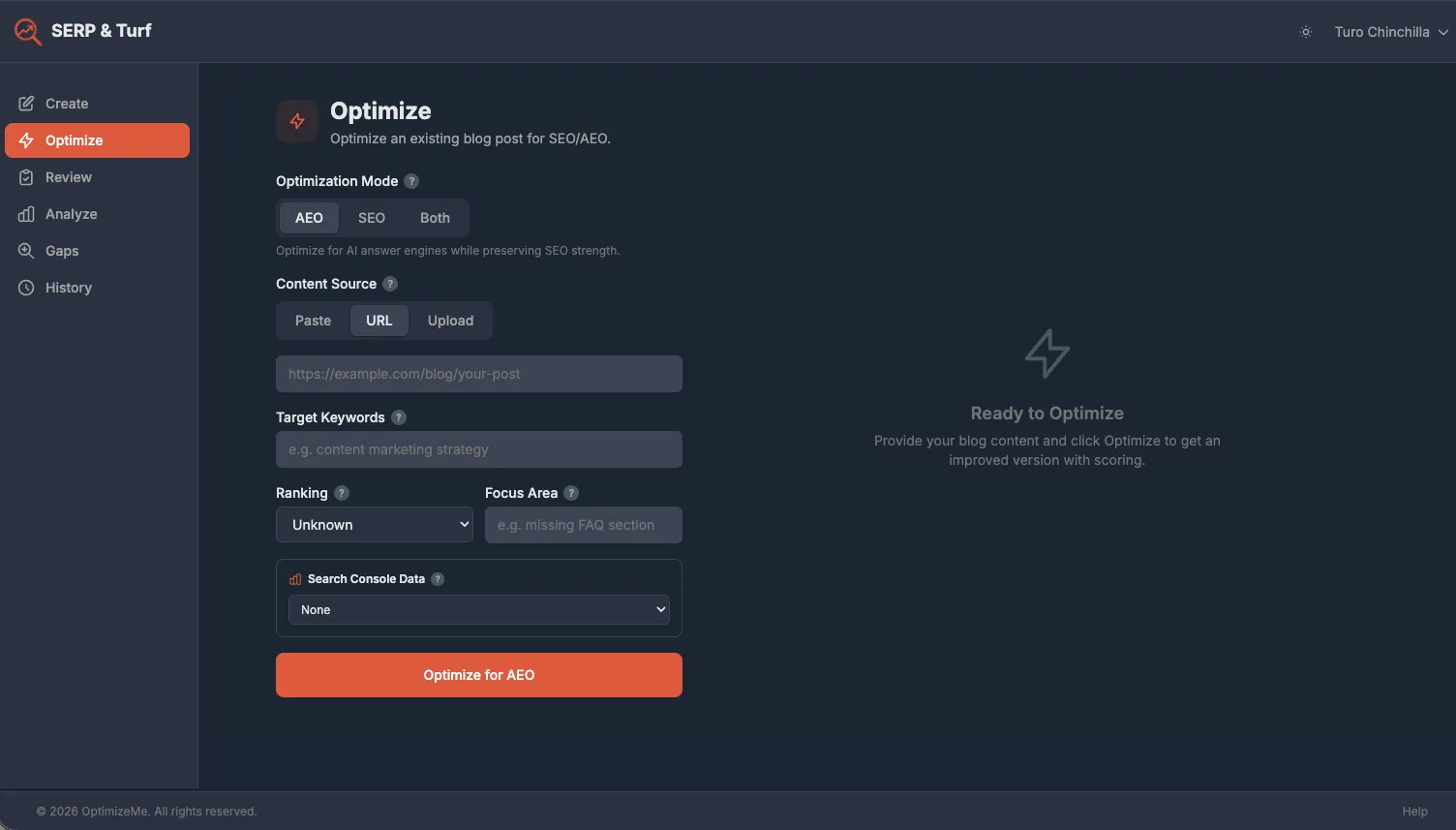
SERP & Turf is the AI-powered SEO and AEO tool we built specifically for this problem. It has four workflows:
- Create - generate a new AEO-optimized blog post from scratch with target keywords + reference URLs
- Optimize - paste an existing post, get back an AEO-optimized version with all 8 steps applied
- Review - side-by-side comparison of old vs new with structural scorecards
- Analyze - audit any URL on the web for AEO readiness without making changes
The Optimize workflow does the 8-step playbook above automatically and integrates with HubSpot CMS and WordPress so you can push the optimized version directly back to your blog. We use it on every post we publish - including the post on plotting CRM contacts on a map.
Common AEO mistakes
- FAQ questions duplicate your H2s. They should differ. If a question is already a body H2, the answer is already present and the FAQ entry dilutes the signal.
- FAQPage schema doesn't match visible content. Schema must reflect what's on the page. Mismatched schema is a Google structured data policy violation.
- Optimizing for AI Mode but ignoring classic SEO. If the page doesn't rank, AI engines won't pull it into the citation pool. Both layers still matter.
- Stripping context to chunk passages. Passages should be self-contained, but the post overall still needs to be comprehensive. Don't remove depth to hit a passage length.
- Skipping the TL;DR because it duplicates the opening. It shouldn't duplicate. The TL;DR delivers the conclusion / answer; the opening sets the scene. Different jobs.
Bottom line
AEO is structural work, not creative work. The same 2,000 words can rank without being cited or rank and be cited - the difference is structure. Run any existing blog post through the 8-step playbook above and it'll move from "ranks but invisible in AI search" to "ranks and gets cited."
If you want to skip the manual work, SERP & Turf automates the entire playbook for HubSpot and WordPress sites.
Frequently asked questions
SEO optimizes a full page for ranking in classic blue-link search results. AEO (or GEO - Generative Engine Optimization) optimizes individual passages within the page for extraction and citation by AI search engines. They're complementary, not competing - a page should pass both layers to win in 2026. For a fuller treatment of how the two relate, this analysis of whether AEO will replace SEO is a good companion read.
Re-citation by AI engines typically happens within 2-4 weeks after Google re-crawls the updated content. ChatGPT's web search and Perplexity refresh their content snapshots more frequently than Google's main index, so citation pickup often shows up before any classic ranking changes do.
Both, but optimizing existing posts has higher short-term ROI. Posts that already rank are in the citation candidate pool - structural changes flip them from "could be cited" to "actually cited." New posts have to earn the ranking first before AEO gains kick in.
Partially. AI Mode pulls from the same index but uses different ranking and selection logic - it favors structured content, citable passages, and pages with strong entity signals. Some pages that don't rank in classic search still get cited in AI Mode if they have strong AEO structure. The reverse also happens.
Yes. Google restricted FAQ rich results in SERPs to government and healthcare sites in August 2023, but FAQPage schema is still actively parsed by ChatGPT, Perplexity, Bing Copilot, and Google AI Mode for content extraction. The schema is valid Schema.org markup, doesn't trigger penalties, and continues to improve AI citation rates.