

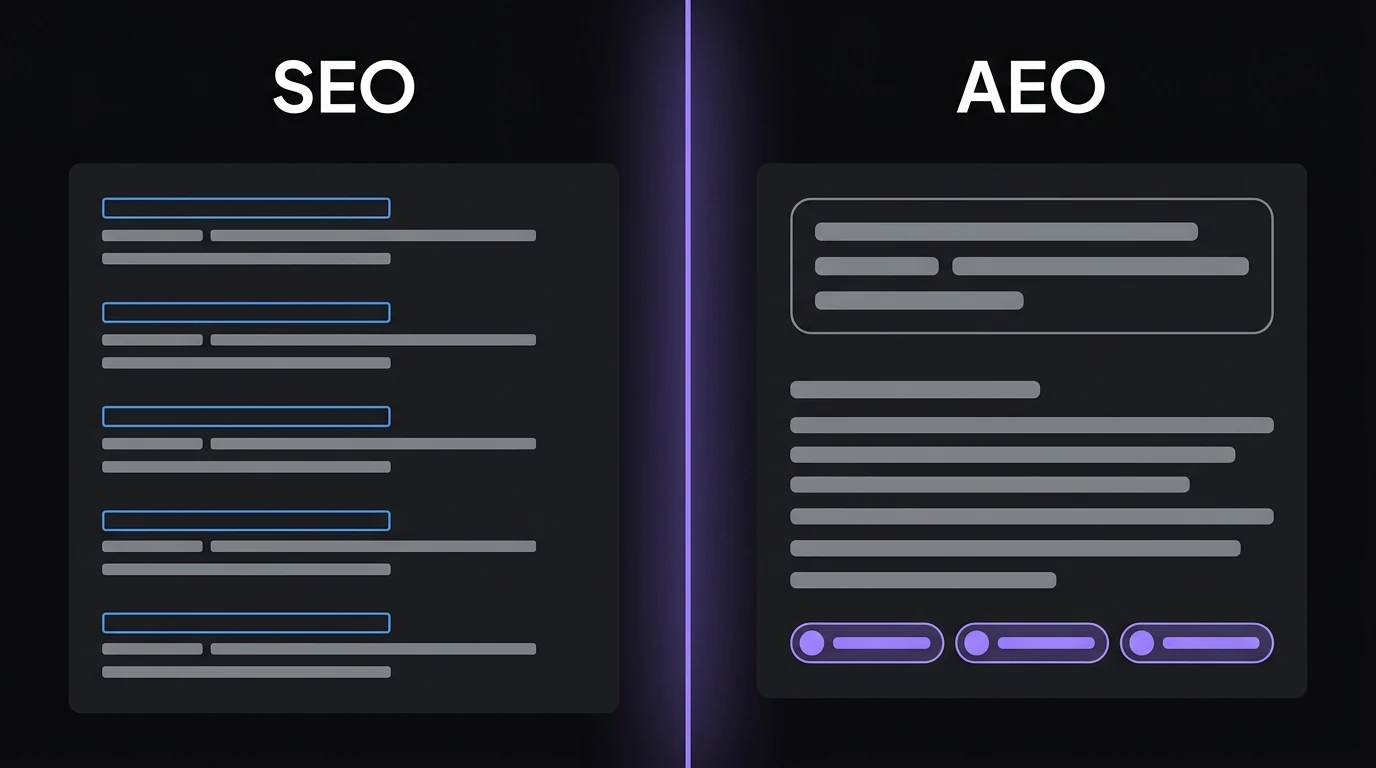
AEO and SEO aren't competing approaches - they're two layers of the same content stack. SEO optimizes whole pages for ranking in classic blue-link results. AEO optimizes individual passages for citation by AI engines like ChatGPT, Perplexity, and Google AI Mode. A page should pass both layers to win in 2026. The structural changes for AEO don't hurt SEO; they help it.
The difference between AEO and SEO in 2026 is not "old vs new" or "Google vs ChatGPT." It's two layers of optimization working on the same content - and most marketing teams now need both.
You wrote a 1,500-word blog post that ranks on page one for the target keyword. It still pulls organic traffic. But when you ask ChatGPT or Perplexity a question your post directly answers, your URL never shows up. That's the AEO gap. Closing it doesn't break your SEO; it builds on top.
What is the difference between AEO and SEO?
SEO (Search Engine Optimization) optimizes a full page for ranking in classic blue-link search results. It judges the page as a unit using signals like title tags, meta descriptions, internal links, backlinks, page speed, and topical depth. The goal is moving up the SERP for a target query.
AEO (Answer Engine Optimization), also called Generative Engine Optimization or GEO, optimizes individual passages within the page for extraction and citation by AI search engines. It judges 130-170 word chunks for self-containment, structure, and citability. The goal is being the source AI cites when answering a question.
The two layers operate on different units. SEO optimizes the page; AEO optimizes the passage. Both can succeed independently, but in 2026 a page that wins in only one layer leaves real visibility on the table. For a deeper take on why the layers matter together, this analysis of whether AEO will replace SEO is a good companion read.
Why AEO became a separate discipline
AI search engines parse content differently than classic crawlers. Classic Google reads the whole page, calculates relevance and authority signals, and decides where to rank it. Generative engines like Google AI Mode, ChatGPT web search, and Perplexity do something extra: they extract a specific passage and cite the URL it came from.
That extra step rewards different signals. A page can rank well for a query but have its passage skipped because a competitor's better-chunked, better-structured passage gets extracted instead. AEO emerged as a discipline in 2024-2025 once that asymmetry became measurable. Publications like Search Engine Land and Search Engine Journal now run regular analysis of which structural signals AI engines weight most.
What SEO still does (and AEO doesn't replace)
These layers haven't changed. AEO doesn't replace any of them:
- Title tag and meta description optimization
- Heading hierarchy with the primary keyword in H1
- Page speed and Core Web Vitals
- Internal linking and crawl depth
- Backlinks from authoritative domains
- Schema markup (BlogPosting, BreadcrumbList, Organization)
- Mobile-friendly rendering and HTTPS
- E-E-A-T signals at the page and domain level
If your SEO foundation is weak, AEO can't compensate. Pages that don't rank in classic search rarely make it into the AI citation candidate pool, because AI engines build that pool from URLs already appearing on page 1-3 of related queries. SEO is still the gate.
What AEO adds on top of SEO
AEO is the layer of structural changes you make to the same content to win citation, not just ranking. The pattern:
- TL;DR or callout block at the top with a direct answer
- Bold-defined key terms on first use (
**Term** is...) - H2s phrased as questions where natural
- 130-170 word chunks per H2 section (optimal AI passage length)
- Comparison tables for structured data (cited at significantly higher rates than equivalent prose)
- A 3-5 question FAQ at the bottom paired with FAQPage schema
- 5-8 external links to authoritative domains
We covered the full restructure in our AEO playbook. For the diagnostic angle - the 5 reasons a post might be skipped by AI engines - see why ChatGPT isn't citing your blog posts.
Side-by-side comparison
| Layer | SEO | AEO |
|---|---|---|
| Unit of optimization | Whole page judged for ranking | Individual 130-170 word passages judged for citation |
| Primary signals | Title tag, meta description, backlinks, page speed, topical depth, E-E-A-T | Definition patterns, question H2s, passage length, FAQPage schema, structured tables |
| Where the win shows up | Top 10 organic positions in classic Google or Bing SERP | Citation footnote in ChatGPT, Perplexity, AI Mode, Bing Copilot answers |
| Tooling that's matured | Established (Search Console, Ahrefs, Semrush, Yoast) | Emerging (purpose-built AEO platforms like SERP & Turf, GEO modules added to classic SEO suites) |
| Time horizon for results | 4-12 weeks for ranking change after content updates | 2-4 weeks for AI citation pickup after re-crawl |
| Replaceable by the other? | No - AEO depends on SEO ranking to enter the citation pool | No - SEO ranking alone doesn't earn AI citation |
The right reading of this table: AEO sits on top of SEO. You can't skip the bottom layer.
How to optimize for both at the same time
The good news: AEO structural changes don't hurt SEO. They help it. Specifically:
- TL;DR cards improve dwell time (positive engagement signal Google uses)
- Question H2s match People Also Ask queries (better featured snippet eligibility)
- 130-170 word passages improve scanability (positive UX signal)
- Tables get featured snippet treatment in classic Google search
- FAQPage schema doesn't trigger SERP rich results for non-gov/health sites since August 2023, but it's still valid Schema.org markup that AI engines parse
Optimizing for AEO produces a side benefit of better SEO. The reverse isn't true. Optimizing only for SEO leaves the AEO layer untouched.
The practical workflow: write the post for SEO first (target keyword, hierarchy, quality), then layer the AEO structural changes on top before publishing. Or, if the post already exists and ranks but isn't getting cited, run it through the AEO playbook as an optimization pass.
A real example: same post, two layers of optimization
Take a hypothetical post titled "10 Email Subject Line Mistakes":
SEO optimization:
- Title front-loads "Email Subject Line Mistakes" keyword
- Meta description 150 chars with the keyword
- One H1 with the keyword
- 1,800 words on the topic
- Internal links to 3 related posts
- BlogPosting schema
That's a complete SEO pass. The post will probably rank if the topic isn't oversaturated.
AEO optimization (layered on top):
- Add a TL;DR card at the top with the answer-first 2-3 sentence summary
- Rephrase H2s like "Mistake 1: Generic Subject Lines" into "What's wrong with generic subject lines?"
- Chunk each mistake into a 130-170 word section
- Add a comparison table (good vs bad subject line examples with full descriptive sentences)
- Add a 5-question FAQ at the bottom that doesn't duplicate the body H2s
- Add FAQPage schema alongside BlogPosting
Same word count. Same topic. Same internal links. The AEO pass adds structure that satisfies both layers.
Tools that handle both layers
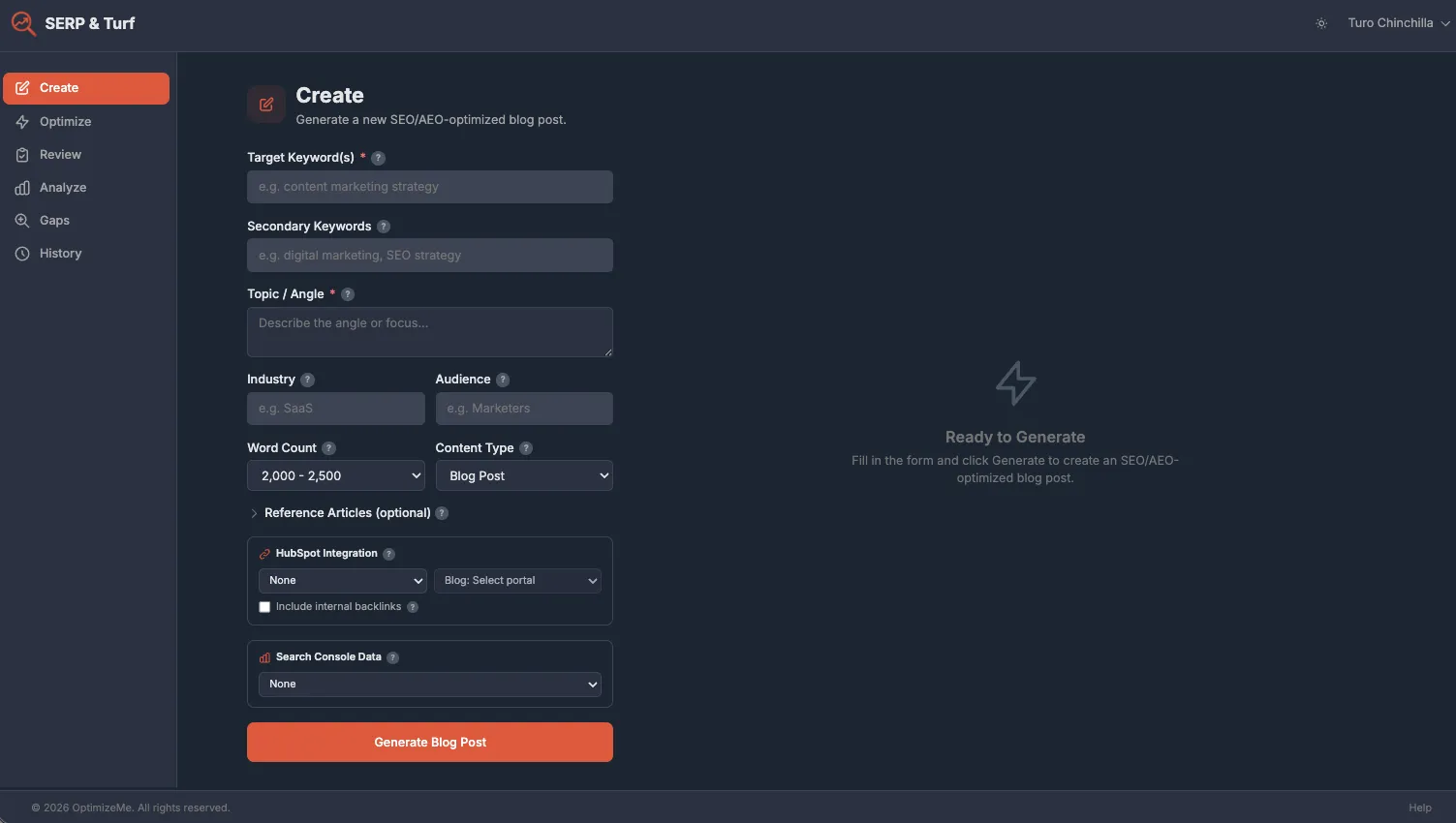
SERP & Turf is the AI-powered SEO and AEO blog optimization tool we built for this. Its four workflows handle both layers:
- Create - generate a new blog post optimized for both SEO ranking and AEO citation
- Optimize - take an existing post that ranks but isn't getting cited, restructure it for AEO without losing the SEO ranking factors
- Review - side-by-side comparison of original vs optimized with structural scorecards for both layers
- Analyze - audit any URL against SEO and AEO criteria, identify which layer needs work
It integrates with HubSpot CMS and WordPress so you can push the optimized version directly back to your blog.
Bottom line
AEO didn't replace SEO and won't. It's an additional layer of structural optimization on top of the same content. In 2026, marketing teams need both. The good news is that AEO changes generally help SEO too - the reverse just isn't always true.
If your existing posts rank but don't get cited, the answer isn't to start over. It's to layer AEO structure onto what you've already built. The investment is hours per post, not weeks.
Frequently asked questions
No, at least not in the foreseeable future. AI search engines build their citation pools from URLs already ranking on page 1-3 of classic search results, which means SEO ranking is still the entry condition for AEO citation. Even when AI Mode-style search becomes more dominant, the underlying signals AI engines use to evaluate which pages are trustworthy still come from classic SEO indicators like backlinks, domain authority, and content depth.
Both, but optimizing existing posts has higher short-term ROI. Posts that already rank are in the citation candidate pool - structural changes flip them from "could be cited" to "actually cited" within 2-4 weeks. New posts have to earn the SEO ranking first, which takes longer. Start by running AEO optimization on your top 10 ranking posts, then apply it to all new content going forward.
Partially. The AEO playbook applies cleanly to informational content (blog posts, guides, FAQs, glossary entries). Product pages and category pages need different treatment because their primary intent is transactional, not informational. AI engines do cite product pages occasionally for "best [product]" queries, but the structural rules differ. The shared signal across both: clear definition patterns and structured comparison tables help in either context.
SEO success: Search Console impressions, clicks, and average position for target queries. AEO success: manual checks of whether your URL appears in citation footnotes when running target queries through ChatGPT, Perplexity, and Google AI Mode. There's no native equivalent of Search Console for AI citation yet. Some emerging tools track AI citation rate as a KPI alongside organic traffic, but the field is early.
Yes, both have started rolling out generative search modules in 2025-2026, but they're early-stage compared to purpose-built AEO platforms. The general pattern: established SEO suites are adding AEO as a feature, while new AEO-first tools (like SERP & Turf) are adding SEO as a feature. Either category works for most teams - what matters is that the platform handles both layers, not just one.