
If your blog post ranks but doesn't get cited by ChatGPT, Perplexity, or Google AI Overviews, the cause is almost always one of five things: weak passage structure, statement-format H2s, missing FAQPage schema, low domain authority, or the post not being in the citation candidate pool at all. Each is fixable. The most common single cause is the first one.
You wrote a 1,800-word blog post six months ago. It ranks on page one for the target keyword. It still pulls organic traffic. But when you ask ChatGPT or Perplexity a question your post directly answers, your URL never shows up in the citations.
That's the AEO gap, and it's almost always traceable to one of five problems.
What does it mean for AI engines to "cite" a blog post?
AI citation is when a generative search engine (ChatGPT web search, Perplexity, Google AI Mode, Bing Copilot) extracts a passage from your page and attributes it to your URL in its answer. Unlike classic SEO ranking, which judges whole pages, AI citation operates at the passage level. The same article can rank well in classic search and never get cited - or get cited but not rank.
The two layers use overlapping but different signals. Closing the citation gap means optimizing for the citation layer specifically.
Reason 1: Your content isn't structured for passage extraction
This is the single most common cause. AI engines extract self-contained chunks of 130-170 words and cite them. If your blog post is one continuous flow of prose, the AI engine has to slice through it without natural section boundaries, and it usually picks a competitor's better-chunked passage instead.
Signs you have this problem:
- Long H2 sections (300+ words) with no subheadings
- Wall-of-text paragraphs (5+ sentences each)
- No TL;DR or callout block at the top
- No comparison tables, lists, or visual breaks
The fix: chunk every H2 section to 130-170 words, add a TL;DR card at the top, and convert dense paragraphs into bulleted or numbered lists where the content suits it. We covered the full restructure in our AEO playbook.
Reason 2: Your H2s are statements, not questions
Compare these two H2s:
- "Subject Line Best Practices" (statement)
- "What makes a high-converting email subject line?" (question)
AI engines preferentially cite content under question-format headings because user prompts to ChatGPT and Perplexity are themselves questions. Question H2s match the prompt-to-passage pattern AI search engines use to extract answers. Statement H2s force the engine to do more interpretive work and the citation often goes to a competitor with question H2s instead.
The fix: rephrase H2s as questions wherever it reads naturally. Don't force questions on H2s where it makes the writing awkward - 60-70% question H2s is a good target.
Reason 3: You're missing FAQPage schema
FAQPage schema explicitly hands AI engines structured Q&A pairs they can extract verbatim. Google restricted FAQ rich results in classic SERPs to government and healthcare sites in August 2023, but ChatGPT, Perplexity, Bing Copilot, and Google AI Mode still parse FAQPage JSON-LD as a citation signal.
A blog post with five well-formed FAQ questions and a matching JSON-LD block typically sees a measurable lift in AI citation within 2-4 weeks of being re-crawled.
The fix: add a "Frequently asked questions" section at the bottom of every blog post with 3-5 questions, then inject matching FAQPage schema. The questions should differ from your body H2s - duplicates dilute the signal.
Reason 4: Your domain authority is too low for AI engines to trust
AI engines weigh domain-level authority differently than classic Google. They preferentially cite content from domains that are already established as authoritative on a topic. If your domain is brand new or has limited topical depth, even structurally perfect content may not get cited.
Signs you have this problem:
- Your site is under 6 months old
- You have fewer than 10 indexable content pages on the topic
- You have few or zero external backlinks
- The topic is competitive (lots of established sites already covering it)
The fix is slower: publish more content on the topic to build topical authority, earn external links from authoritative domains, and get mentions on platforms AI engines weight heavily (Reddit threads, Wikipedia references, established publications). Search Engine Land and Search Engine Journal both publish ongoing analysis of which signals AI engines weight most. For a broader take on how AI search is reshaping site strategy, this piece on what AEO means for the future of websites is worth reading alongside this post.
Reason 5: You're not in the citation candidate pool at all
AI engines build their citation pool from pages that already rank somewhere on the first 1-3 pages of classic search results for a related query. If your post doesn't rank, it doesn't even get considered for citation, no matter how well-structured it is.
Signs you have this problem:
- Your post sits past page 3 in Google for any related query
- The target keyword has no impressions in Search Console
- The page hasn't been indexed yet
The fix is classic SEO first, AEO second: improve title relevance, internal linking, and on-page authority signals so the post enters the candidate pool. Then layer on AEO structural changes. The order matters - AEO without classic SEO ranking gives you a perfectly structured page that no AI engine ever sees.
How to diagnose your own blog post
Run this 5-minute audit on any post that ranks but doesn't get cited:
- Open the post and count words per H2 section. Anything over 250 words gets flagged.
- Read each H2 aloud. Does it sound like a question someone would ask ChatGPT? If half or fewer pass, flag it.
- View the page source and search for
FAQPage. If absent, flag it. - Search Google for a query your post should rank for. Is your post in the top 30 results? If not, flag it.
- Search ChatGPT for the same query. Is your URL in the citations? If not, you have the AEO gap.
The number of flags tells you which of the 5 reasons applies most. Fix the highest-flag issue first.
Tools that diagnose and fix this automatically
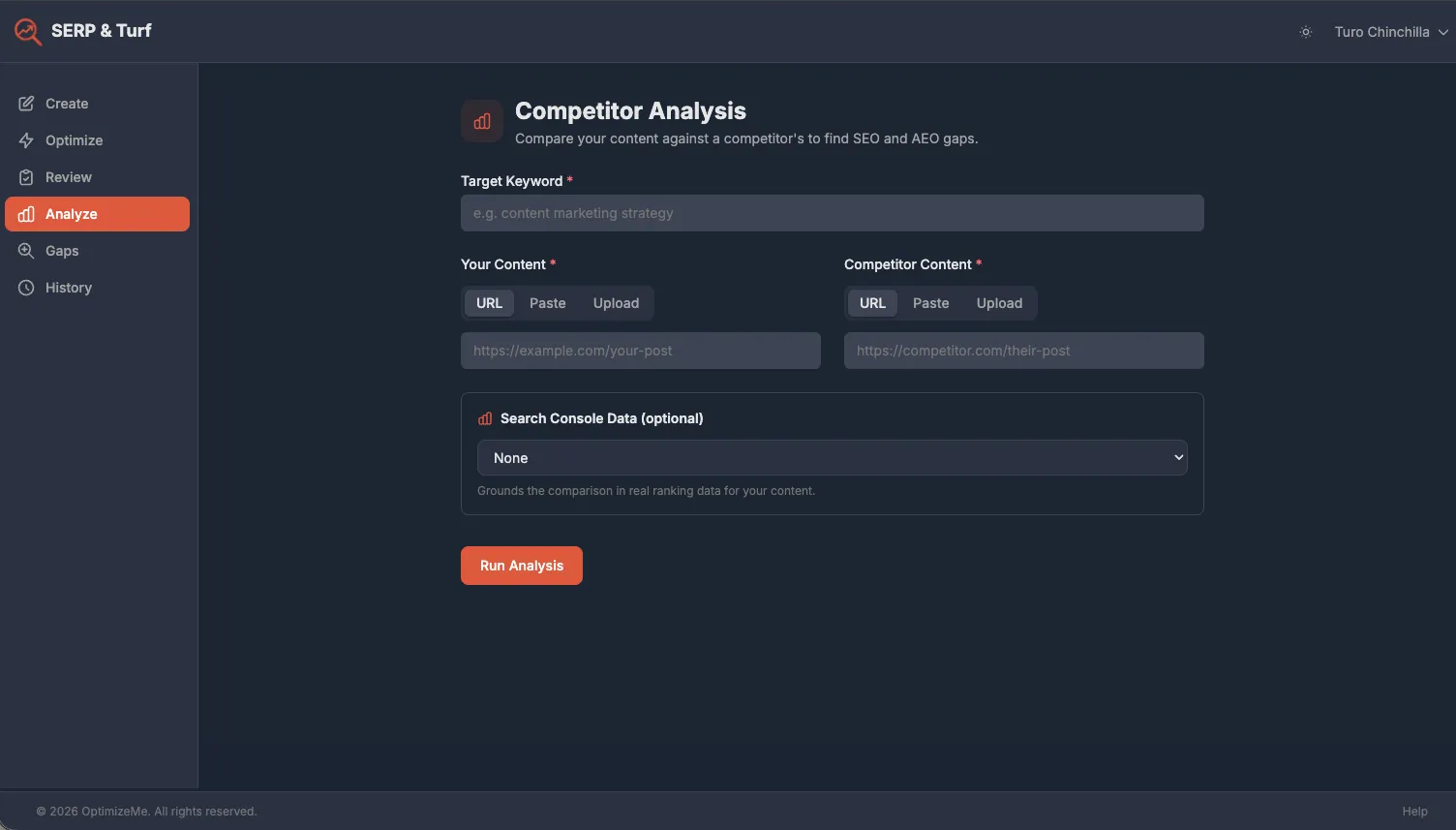
SERP & Turf is the AI-powered SEO and AEO tool we built for this exact diagnosis. The Analyze workflow audits any URL against all five citation criteria above and produces a structural scorecard. The Optimize workflow then rewrites the post to fix the issues, ready to push back to HubSpot or WordPress.
Bottom line
If your post ranks but isn't cited, it's almost always a structural problem in your existing content - not a fundamental quality issue. The 5 reasons above are individually fixable in under an hour each. Run the 5-minute audit on your top 10 posts, identify which reasons apply, and prioritize the structural fixes.
Once a post is in the citation pool with the right structure, AI citation typically picks up within 2-4 weeks of the next crawl.
Frequently asked questions
Run the same query you'd want your post to answer in ChatGPT (web search enabled), Perplexity, and Google AI Mode. Check whether your domain appears in the citation footnotes. There's no equivalent of Google Search Console for AI citation yet - manual checking is still the standard. Some emerging tools track AI citation rates as a KPI but the field is early.
Partially. Both reward structured passages, question-format H2s, and FAQPage schema. Differences: AI Mode pulls more heavily from Google's own index and Knowledge Graph entities, while ChatGPT's web search uses Bing's index and weights real-time content more heavily. A page that satisfies AEO structural rules tends to do well in both, but absolute citation rates differ. For more on how AI Mode and classic Google search relate, see our AEO vs SEO breakdown for 2026.
Re-citation by AI engines typically happens within 2-4 weeks after Google re-crawls the updated content. ChatGPT's web search and Perplexity refresh more frequently than Google's main index, so you may see citation pickup before any ranking changes show in Search Console.
SERP & Turf audits any URL against the criteria in this article and produces a structural scorecard with specific recommendations. Some general SEO platforms like Semrush and Ahrefs have started rolling out GEO modules but they're early-stage compared to purpose-built AEO tools.
For competitive informational queries in your niche, anything above 5% citation rate (your domain shows up in roughly 1 of every 20 ChatGPT or Perplexity answers for those queries) is solid for a small site. Established publications hit 15-30% in their topic areas. Treat the metric as directional, not absolute - the methodology for measuring it varies between tools.